Swarm Robotics · Optimization Alvik Swarm — Multi-Robot Routing on a Physical Grid
Primary researcher: Andrew Muszynski
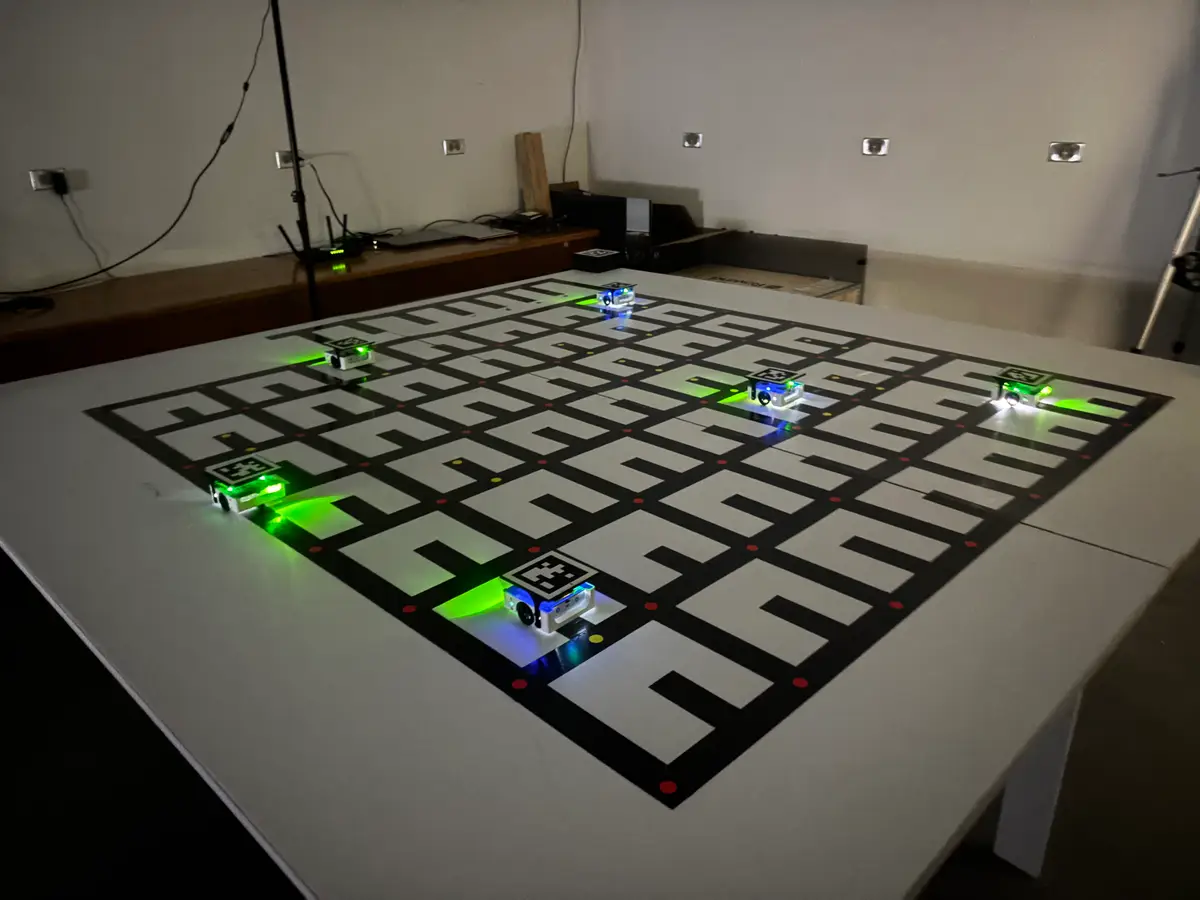
A fleet of Arduino Alvik rovers turns a classic optimization problem into moving hardware. The
rovers operate on a printed grid beneath a fixed overhead camera; each carries an AprilTag on
its top plate, so the moment a powered-on rover enters the camera’s view it is registered by
the central server and appears on the control page. Commands are issued to the whole swarm from
the server’s dashboard.
The system localizes each rover by fusing wheel odometry with the overhead camera’s AprilTag
detections — correcting the drift that odometry alone accumulates. On top of that positioning layer, a
genetic algorithm routes the swarm through a complex variant of the traveling-salesman problem:
“operators” are dropped off at grid locations and must be picked up again later, and the
measured objective is the full execution time of the system. The goal is to make the robots
reflect a real-world routing and logistics optimization problem — algorithm to action.
Master's Thesis Research Edge-Delegated Authorization for Industrial Robots
Primary researcher: Luke Pepin
A healthy robotic workcell can lose production time when a network outage prevents headquarters
from authorizing its next job. This thesis asks how constrained cryptographic delegation affects
job completion, admission enforcement, and the authority available to an attacker with stolen keys.
Three approaches are compared:
- Central authorization: headquarters approves each new job; approvals wait during an outage.
- Pre-issued offline permission: the requester selects jobs within a reusable credential’s limits.
- Local delegation: a bounded local issuer approves jobs serving the current work order with single-use permits.
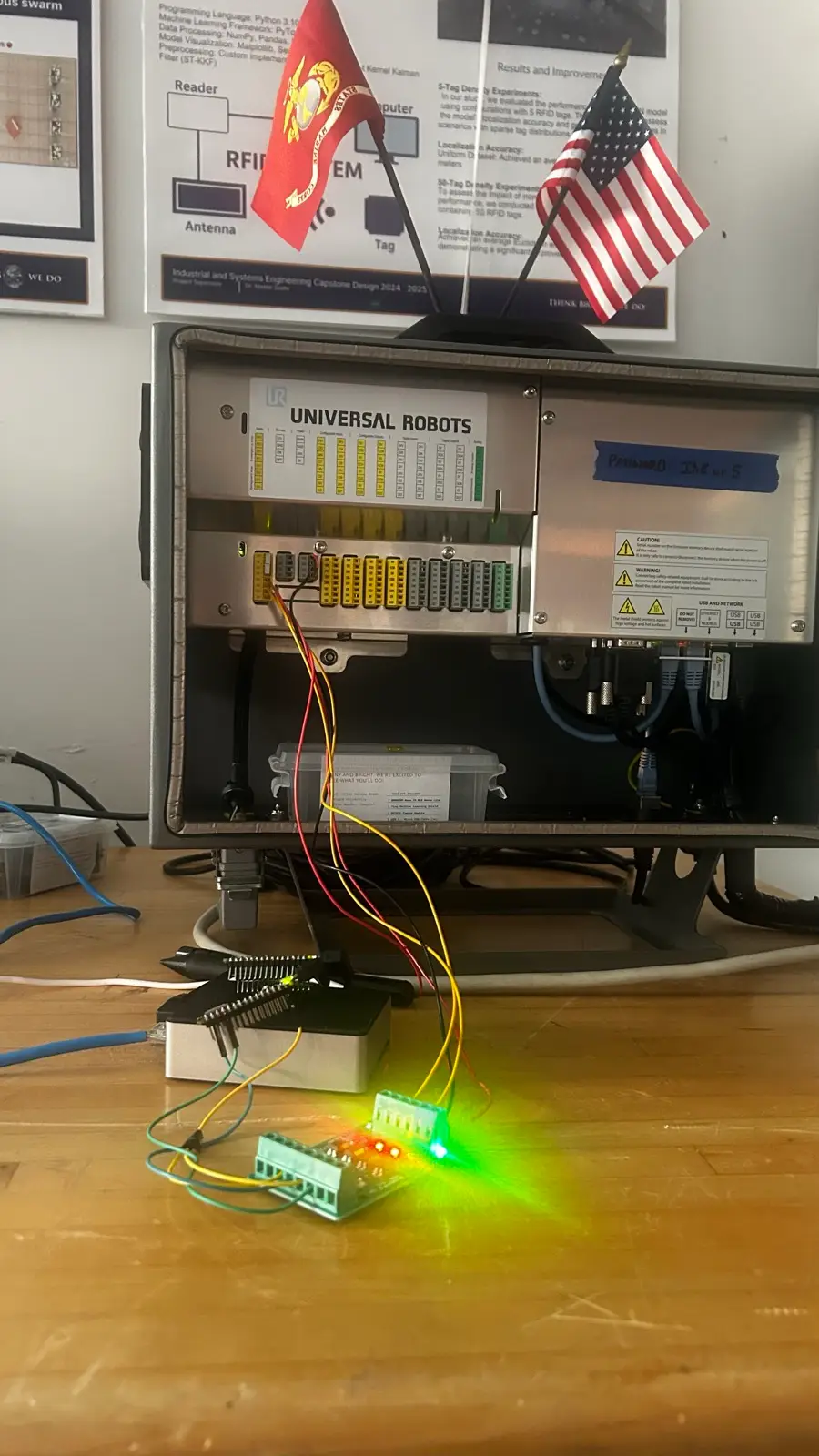
Hanoi disk-transfer jobs on a UR5 provide the workload. Planned software tests, simulations, and
physical trials compare the modes at three authority levels: fixed sequences, routine moves,
and routine plus recovery. Ed25519 signatures and a Raspberry Pi verifier enforce authority
limits and reject replays.
The study tests delegation’s potential security benefits against added latency and issuer failure.
Separate key custody is assumed; host compromise and revocation during outages are outside scope.
Research in progress. The scope and minimum evidence remain pending advisor review; the proposed benefits are hypotheses to test. The safeguard interface is a prototype, not certified functional safety.
Industry 4.0 Special Projects · ISE 575 Marco Polo — Precision Indoor Asset Tracking
Primary researcher: Luke Pepin ·
Supporting: Jay-Sun Rutledge, Seun Filaoye
Marco Polo is a precision indoor tracking and localization system built as the final project of
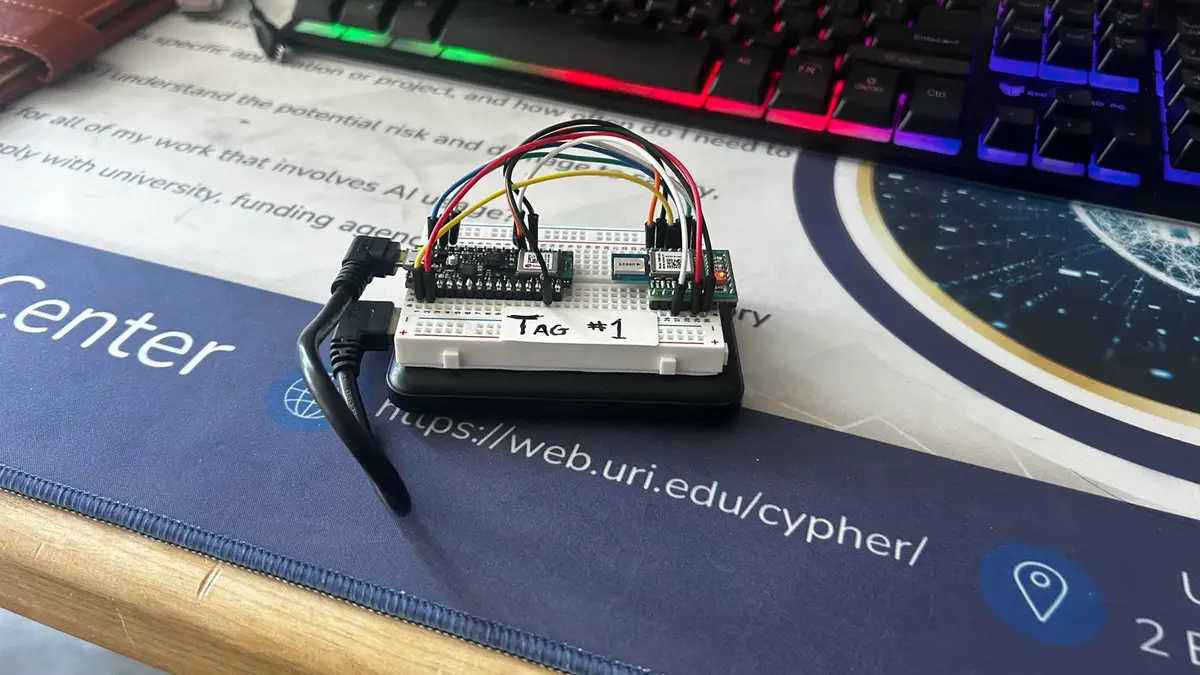
the Industry 4.0 certificate sequence. A distributed Ultra-Wideband (UWB) multi-node network —
three fixed “seeker” nodes and a mobile “hider” tag — achieves centimeter-level indoor
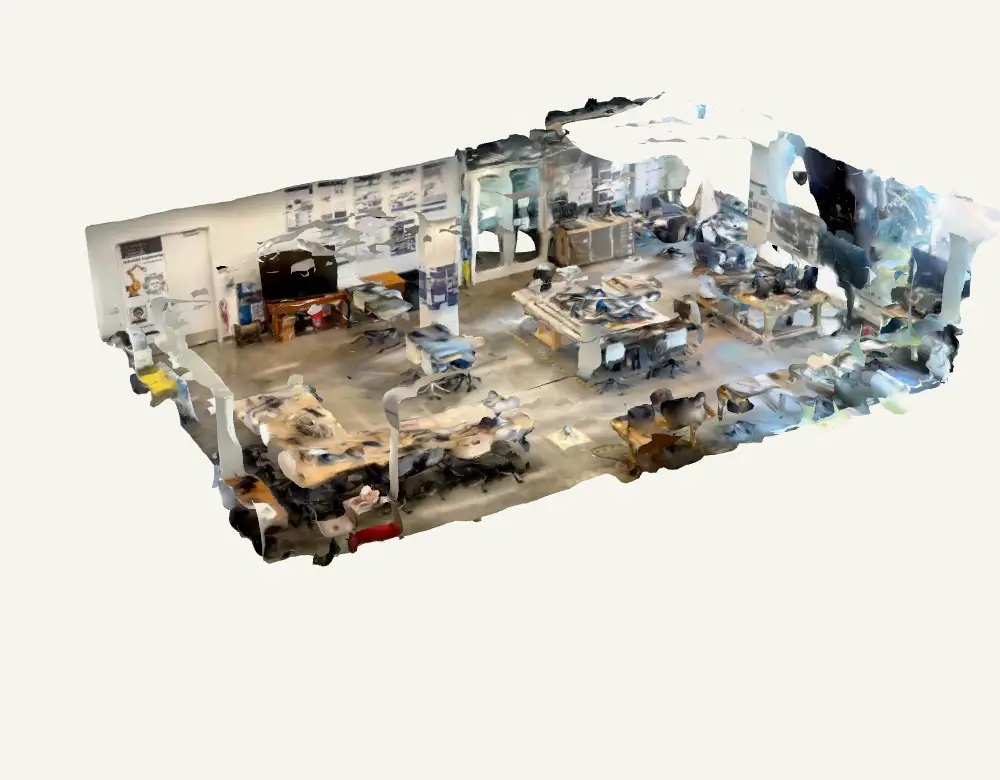
positioning, mapped in real time onto a Unity digital twin of the capstone lab through 3-D
trilateration.
The system separates real-time sensing from high-level visualization in three layers:
- Sensor coprocessor — An Arduino Nano 33 BLE drives each DWM1000 UWB radio
over SPI, dedicated entirely to two-way ranging so timing-critical measurements are never
interrupted, with carrier-integrator clock-offset correction against temporal drift.
- Data router — Raspberry Pi 4 base stations parse the serial telemetry, apply
median and moving-average filtering, and publish clean JSON to a central MQTT broker on the
local network.
- Visualization engine — The Unity digital twin subscribes to the broker and
runs a gradient-descent non-linear least-squares solver to intersect the three seeker
distances and track the hider in true 3-D space.
Smart Mfg & CNC Sensor-Integrated CNC Machining
Primary researcher: Andrew Oxley
A major thread of the lab’s work is instrumenting CNC machines with sensors and putting that
data to work: machine-learning models for predictive tool wear, digital twins of the machining
process, and data visualization that surfaces overall equipment effectiveness (OEE) for
optimization and performance improvement. Two machines anchor this work:
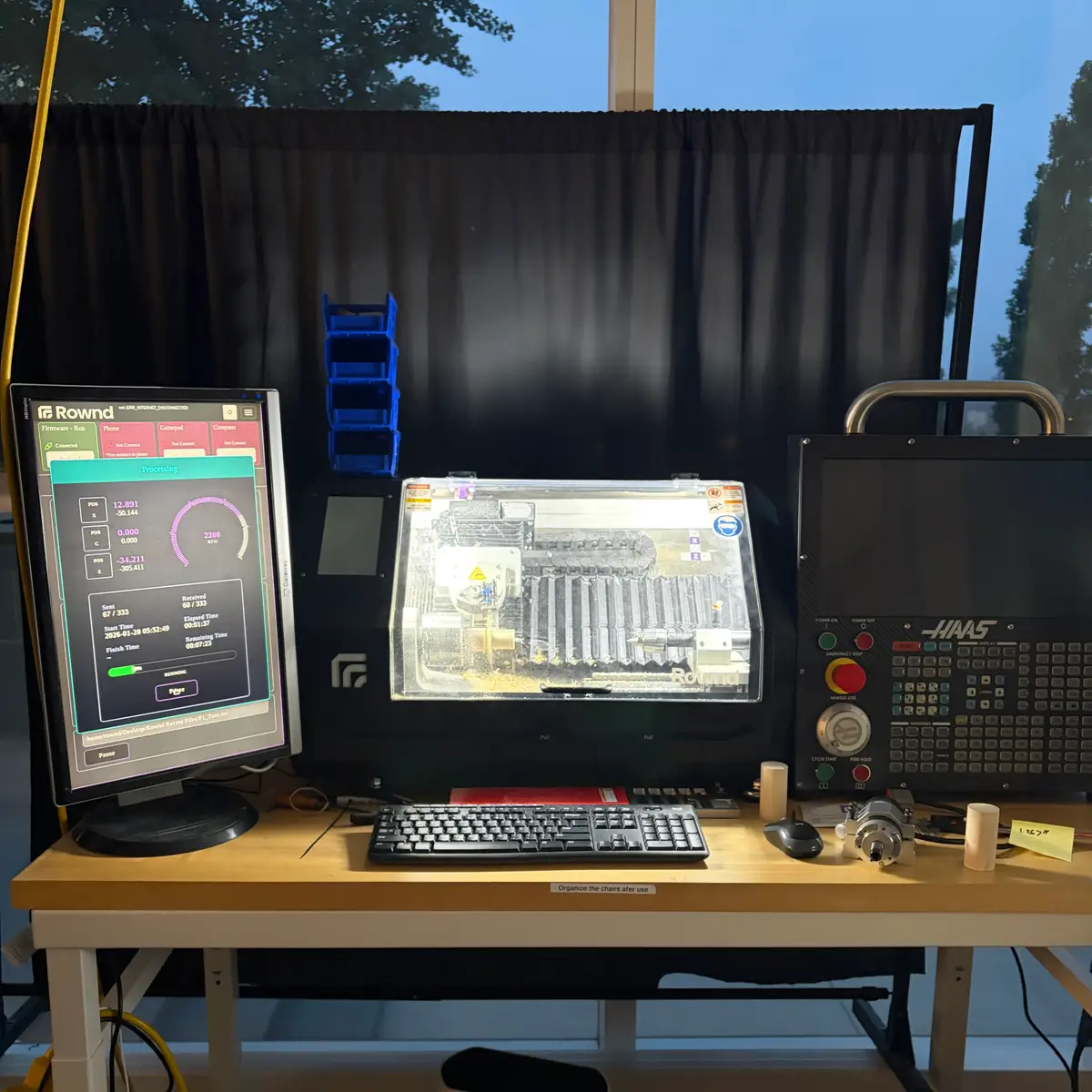
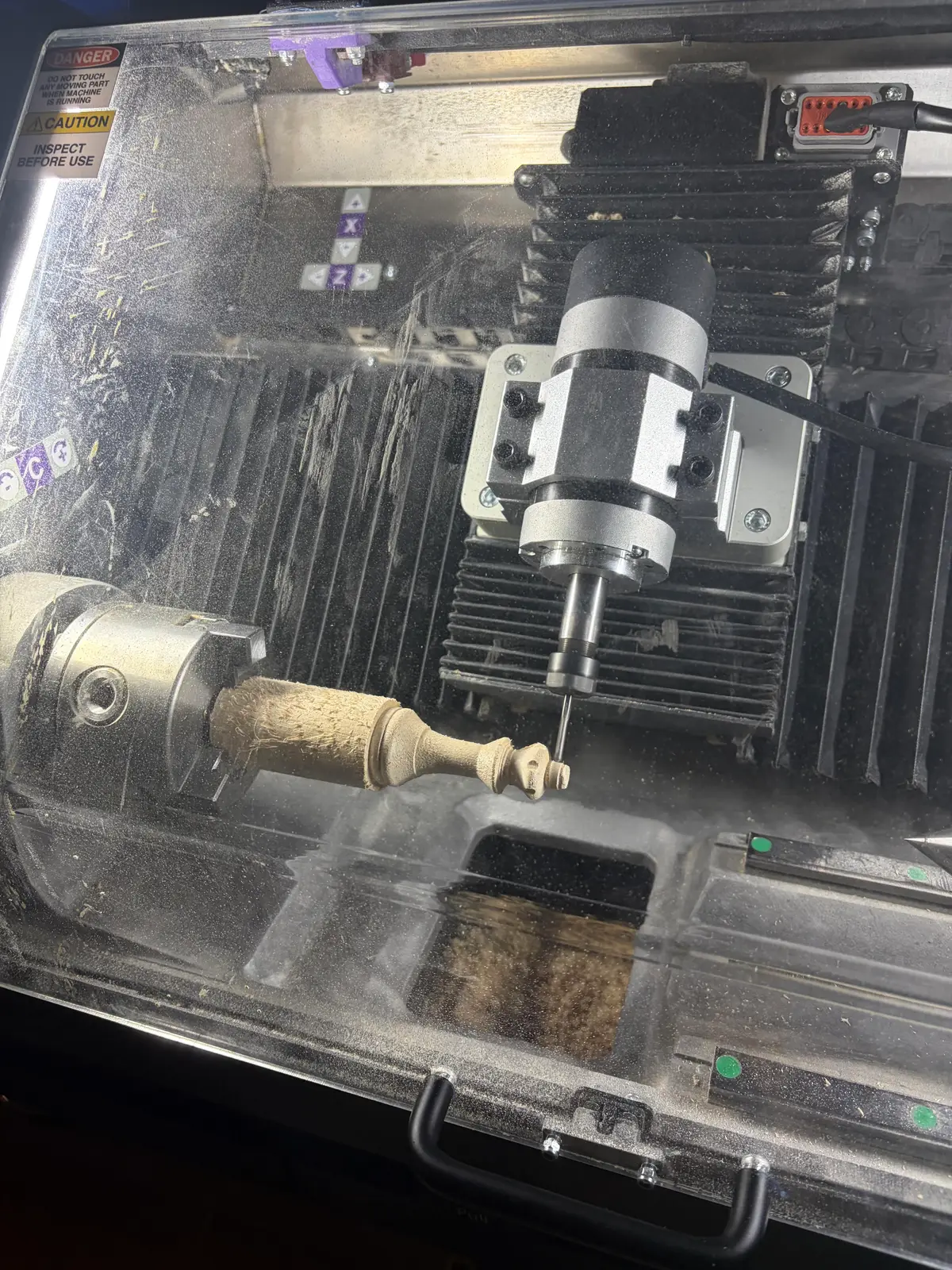
- Rownd CNC lathe — A programmable turning center the lab is using to produce
chess pieces while automating and optimizing the workflow for complex parts that require
4th-axis milling alongside turning.
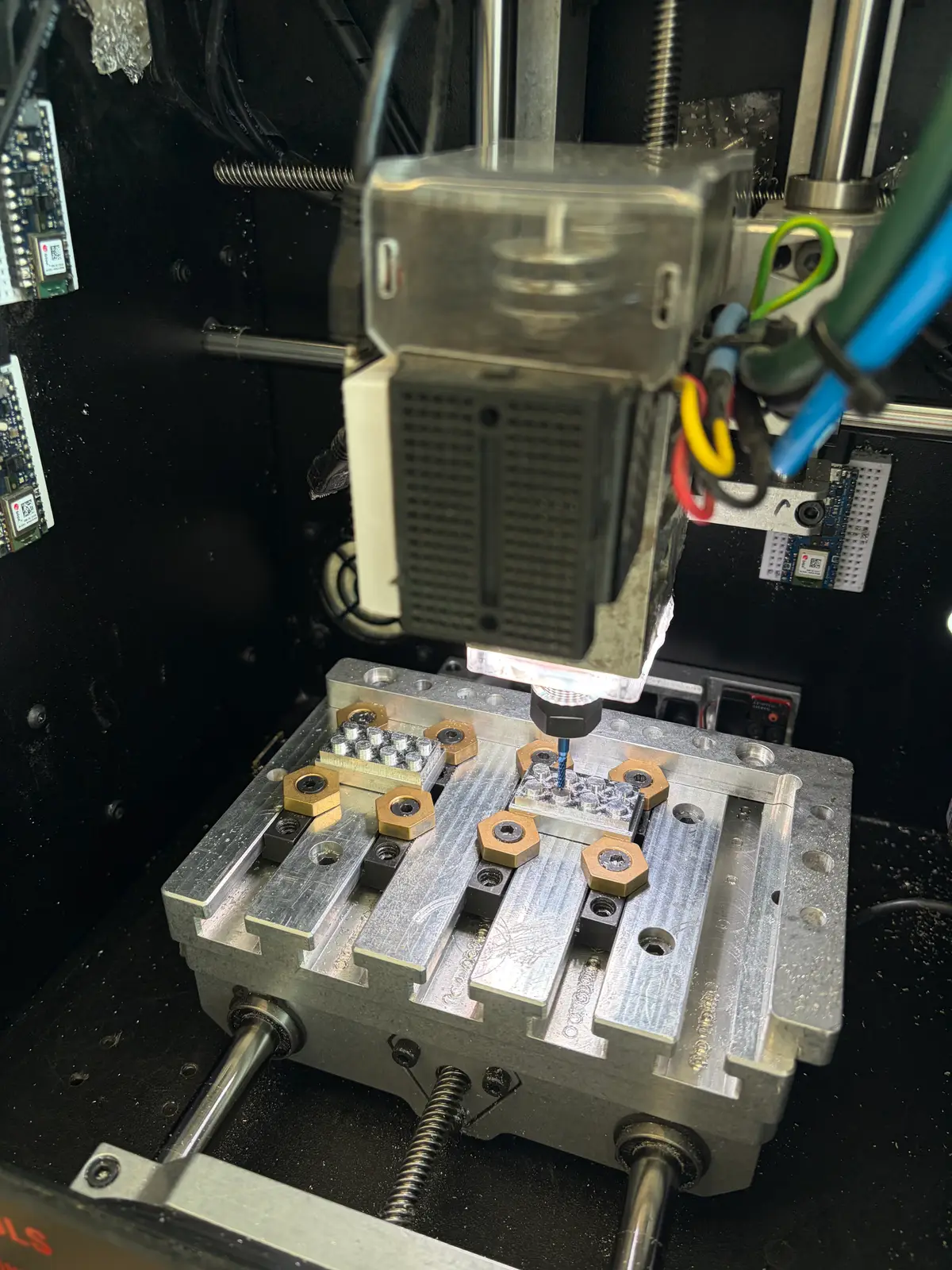
- Compact metal CNC — A small metal-cutting mill producing LEGO-scale parts
with incredibly tight clearances, pushing fixturing and tolerance control at miniature scale.